Showing posts with label Humanities. Show all posts

Saturday, April 25, 2020

What I'll Endured

Endurance is my last humanities course I will taking at GCE. So the following is my last first action project of the term. So far in Endurance, we've explored what endurance looks like mentally and physically. We also had assignments based on self awareness. For this AP, I wrote the first chapter of my autobiography. I wrote about how my adolescence shape me into my future self.

--------------------------------------------------------------------------------

My name is Moriah, I’m more inquisitive than not. Naturally, growing up I had a lot of different interests, ranging from fashion to mathematics; I always had time for a new hobby. There were a lot of art programs that I got into like classical music, band, printmaking, animation, and sewing. This helped me learn how to express myself in ways that made more sense to me. I do remember my favorite pastime though. This was taking photos. Going through them and putting them into photo albums. I loved it, sneaking around the house with my very own camera. I got my first camera when I was a kid as it was a gift from my parents. About a month before I received that gift, I was a patient in the hospital for the first time since my birth. I remember it clearly… I was doing my own thing whilst being watched by my older brothers at home. At the time, I was already embarking to be as independent as I could so I thought that I could make my own tea. No seven year old should really make their own tea without supervision. I did so and just as I was finished, piping hot water spills over my torso, melting my skin off. I had to be rushed to hospital via ambulance after that. Although it could’ve been worse, this is one of my first memories that I probably won't forget. 


Getting burnt wasn’t painful. I didn't feel anything due to the fact that my nerves were completely damaged. The following months after that were extremely brutal, having to recover from surgery and heal all my wounds. That experience taught me a lot about patience and endurance. Even now, I’m never sloppy while making tea. Although I had to take a break from school, once I was back, I hit the floor running. During school, I often got bored a lot. I didn’t have many friends growing up and never felt seen by the people around me. I spent most of my time around family members, especially my grandparents and cousins. I have a lot of family in the south so we were always traveling to either Mississippi or Florida. I always loved to see all the nature while spending time on my family's farms. The way the culture was different from in Chicago intrigued me. I already knew as a kid that I wanted to see what else the world had to offer (often returning home with a preoccupied mind); I wanted to explore other environments. I resorted to writing and reading and that’s how I spent the majority of my pre teen years. A passion for poetry grew which I would later be able to showcase during my late years of high school.


Community service and volunteering was a significant part of growing up. For the majority of my pre-teen years, I was in the Girl Scouts. This organization helped me build strong relationships while learning many valuable skills today. My mother dedicated most of her time helping families and partnering with organizations to give what she can. As a default, I spent my time in those spaces too, learning to look out for people. S made sure I knew that it could always be worse, to remain humble and devout. This did and still does inspire me. I developed rage seeing the injustices and lack of resources that our community faced. This work continued into my time as a high school student, volunteering mostly on the south and west side of Chicago. I even was able to work alongside my mother during the pandemic of 2020. I believe these experiences shaped me into who I am now.

I always had a compass during my teen years. The problem was I was never really content as to where it was pointing. One day during my sophomore year, I came across this film called Drylongso. This film was the first time I felt what it feels like to be represented- A young black woman who explores racial injustices using film photography although the older adults in her life didn't believe in what she did, which is something I too felt throughout my teen years. I related to the main character perfectly and she inspired me to do what I want. For the rest of my High School career, I went to a private school on the north side of Chicago. This environment allowed me to develop a completely different perspective on what my city really was, I was able to make art and explore a lot of creative paths. Towards the end of my time there I realized I was unsatisfied with what I was doing. Yes I did want to continue to grow in creative areas, but I really wanted to explore more STEM concepts and I didn’t really do that for my 11th and 12th grade years.

For college, I went to school in Michigan, not too far from Chicago where I grew up. This experience is something that I wouldn’t trade for anything. I started to be more passionate about my education again which made me happy. The anxiety of doing what I love and not what people expected me to do was a mental struggle for me that I endured all my life and I decided not to let this feeling dictate my undergraduate career. I realized that I didn’t have to be Maya Angelou to write or Albert Einstein to want to experiment. I studied here with a concentration of Community and Global Health. I was able to complete the goal of studying abroad and finally leave the US for the first time. My summers making up of journalism projects, photographing and volunteering. Every time I wanted to give up I just thought of my mom and how I needed to become successful for not only myself but her too.

Now I’m a successful professional while still doing what I love. I graduated as a first generation college student. I’m a healthcare worker while still a writer and photographer. I have a few books out there somewhere from my work throughout my undergraduate experience. My life isn’t what I expected it to be when I was younger. I spent a few years working with Médecins Sans Frontières, which was a goal of mine since I was younger. Life is way more calm now and I’m okay with that. Making my own schedule and dedicating a lot of that time to research. I use what I know and the connections that I've built to offer the help that white America hasn’t, never forgetting where and how I grew up.


--------------------------------------------------------------------------------


I'm taking this class online with the rest of my classmates due to the Covid-19 pandemic. It's interesting to see how my work plays out during this time. Doing this AP was difficult because although I like to write, I hate writing about myself and then having to display it. So this AP was something to endure within itself. I must say it was satisfying having a finished product.

Sunday, February 16, 2020

Legalize it! The Eleventh State

     For the winter term, I'm taking a class called Equality. In the course, we learn about the history behind societal dynamics and how they affect people within their groups or personal identity through race, class, and gender. I saw many different cases of inequality and individual perspectives on the topic. My classmates and I read Case for Reparations by Ta Nehisi Coates, this was something that I've never looked into before or even had the opportunity to learn about. With looking at different historical events and impacts, as an Action Project I had to follow the guiding question of “How can you retell history?”.
     In recent news, marijuana has been becoming more regulated and decriminalized in the media as well as medical spaces. As of January 1st 2020, recreational use of marijuana became legal in Illinois. I think that it's interesting being able to witness something that was once banned on a federal level slowly become legalized for recreational use. Through this Action Project, I used historical research and perspectives of affected people to make a textbook entry of the legalization of cannabis in the united states but more specifically Illinois.


Friday, September 27, 2019

Disservices within Chicago Public Schools


The job of a journalist is to research, document, and share stories that you find important/meaningful. Being a journalist can be a dangerous job and can cost you your life. For my journalism course, my class finished out first unit, “Text”. In this unit we learned what it takes to be a journalist as well as a consumer throughout the different time periods. We analyzed different parts of an article: like the headline, how you would capture this information/ the readers and how you can communicate a message. This led to me thinking about what I could write about.

Disservices within Chicago Public Schools

        “We’ve been using the same books for 10 years. We can't afford anything.” says 17-year-old Kayla who attends King College Prep. Chicago is notorious for having unjust school systems in lower-income neighborhoods predominantly on the south and west sides of Chicago. It’s not news that public schools don’t have the best funding or functionality, some schools more than others. But in circumstances as Kayla (and many others) describes it, there’s an obvious disadvantage to students who go to schools in minority dense neighborhoods. Teachers coming and going has been a big problem within the CPS school system, as well as having fewer resources than other students in higher-income neighborhoods.
        Instability within the staff at schools is detrimental to the success of students. Often when teachers are coming and going frequently, students become less engaged and are less likely to be motivated to learn. “We just lost like 7 teachers and only 3 of them were replaced.” says Kayla. Fewer teachers can translate into many issues. Teachers can likely be coaches or sponsors, helping with extracurricular programs such as sports, or academic teams within the school. Class size is very important to your learning success, it’s easy to trail off in class when you have 20 plus classmates. It may be even easier to overlook a student with an intolerable workload. This may cause a decrease in test scores leading to less funding, something that schools like this have been struggling with already. With fewer teachers, this means that there will be less and less programs to offer. At King College Prep, a librarian no longer worked there, and so students were not allowed to access the library for a year until they were able to find a new teacher, depriving them of a consistent space to study.
        Kayla talks about how she wishes she could experience what other students can .Barely even 5 miles north of her school, a senior, also at a selective enrollment school likely experiences school completely different. At a school like Walter Payton or Jones college prep, the school offers so many resources; 70+ clubs/activities, global class trips, and room for more teacher/student interaction. These things are something that they’re known for. “I think it's unfair to see students within the same system experience a completely different academic environment,” she then continues to express her point “I have friends who attend Walter Payton College Prep and we’ve discussed the difference in numbers with extracurricular activities and clubs. Payton has over 70 clubs while King is losing clubs yearly.”
        This is just one unfortunate situations out of countless others. Talking to Kayla really brought insight to a situation that not a lot of people acknowledges nor try to change. For many students, school is a sanctuary but it truly is providing a disservice to students while simultaneously setting them up for failure in higher education to allow students to continue to attend schools with subpar conditions and education. Every student deserves equal opportunity and hopefully under the new mayoral administration in Chicago, that would be something attainable.


        Deciding to write about this topic came from me having friends who go to public schools here in Chicago and I wanted to know more about my friends perspective. I was able to empathize, having experienced completely different highschools myself. I hear about what they have to go through and how it compares to other schools in Chicago and it’s wrong. Public schools have to fix their system. This project worked out perfectly because I was already with my peer who I interviewed and we regularly have conversations like this. I’m glad I could write an article about this.

Thursday, June 6, 2019

The Policy Podcast; Terminiello v. Chicago (1949)


I'm closing the Chapter for junior year humanity courses. That means that I'm ending my policy course. This course was different for me. I never learned about the government in such an extensive way as we did this term. I'm grateful for everything that I learned about because now my classmates and I have more knowledge on what it means to be a citizen of America, as well as learning different perspectives outside of American citizenship. The first unit we learned about the Legislative branch, the second unit, we learned about the Executive branch. In this unit, we learned what the Judicial branch of the government is all about. Learning about the government, we of course will see some terms that aren't common so my teacher gave us some legal terminology to define. Knowing those terms, it made subjects easier to comprehend. I now understand how a case reaches the Supreme Court. While understanding the process of a case being handled, I got to get to know more of what it means for something to be constitutional or not. So, with learning about the supreme court, we researched different cases, specifically all of the landmark cases, such as Roe v. Wade and Brown v, Board of education. This might've been the most impactful unit for me because I really got a sense of how change happens within the legal world. Some of the cases were even inspiring because it shows that change is worth fighting for and without the fight, nothing will change.

To represent everything that I learned this unit, I made a podcast talking about Terminiello v. Chicago (1949).


There are a lot of interesting and necessary Supreme Court cases, it's not easy to just pick one to look more into. I first thought that I was going to choose Tinker v. Des Moines but someone recommended me to look at Terminiello v. Chicago and I never heard about it. I chose this case after looking at it more because I though it was more interesting than my former choice, although they both have to do with our First amendment rights. I enjoyed making this podcast and while trying to explain what I learned, I even ended up learning more.

Citations
“{{Meta.pageTitle}}.” {{Meta.siteName}}, www.oyez.org/cases/1940-1955/337us1.

“Terminiello v. Chicago, 337 U.S. 1 (1949).” Justia Law, supreme.justia.com/cases/federal/us/337/1/.

Reports of cases adjudged in the Supreme Court of Pennsylvania : [1828-1835] / by William Rawle, jun. ; with notes referring to cases in the subsequent reports by William Wynne Wister, jun

Thursday, May 23, 2019

The injustices of the Iraq War

Policy is a course that I'm taking in my last term as a junior. My classmates and I just ended the 2nd unit of this term, "Executive". The main focus was the executive branch of the US Government. We talked about actions that the executive branch can take and cabinet positions, I specifically looked into the Secretary of Housing and Urban development but I got a chance to look into my classmates positions. We went to the Cook County Criminal Courthouse in this unit and it's so far one of my favorite field experiences, we got to witness part of an actual murder trial. I learned about the wars that had US involvement and what it takes to declare a war. For this Action project, I wrote about how the Iraq war wasn't a just war. I came across this blog that has photographs from the Iraq war and that made me realize how much of an impact the war was.
Marco Di Lauro, 2003
This photo is from the blog of Marco Di Lauro, who at the time worked for  Getty Images News Service. I came across while looking for information on documenting the United states invasion of Iraq. Researching this was very enlightening to what's going on in government decisions and how it affects everyone involved, rather it's direct or indirect interactions.
Here's my paper:


Towards the end of writing this paper, my class visited the National Veterans Art Museum. This went along with my paper because I talked about how soldiers are now affected physically and mentally for the rest of their lives. I saw the photography there, it really connected with me as a viewer even though I have no idea what the soldiers went through while oversee's.

Yeon J. Yue, 2017, Grey American Landscape

 I asked our tour guide does she see a difference in art between the generations of veterans and she said that around the time of the Iraq and Afghanistan war, there was a lot of photography because that was around the time you were first allowed a camera. She also said that soldiers now in this generation turn towards performance art and comedy, I found that really interesting how the mediums changed through the decades. A lot of veterans have different experiences and that can seem really isolated after going to war and they're dropped into regular civilization expected to live it over again.

Yeon J. Yue, 2017, Grey American Landscape

This project was really enjoyable. I like to research and write so I had fun learning about the Iraq war. My favorite part of researching was looking through a theoretical analysis by Kenneth N. Waltz, called Man, the State and War. I'm glad that I chose this war because I feel like I gained so much information on the United states and the war itself. 

Saturday, April 27, 2019

To Danny Davis, vote yes for Border and Refugee Assistance Act of 2019

In my course Policy, we're ending our first unit called legislative. In this unit we learned about different government officials and policies that politicians follow. For one FE, we talked to Mona Noriega and others who work at her office to discuss policies at her office in human relations. We also met the alderman, Andre Vasquez. I wrote my letter to my representative, Danny Davis to advocate for a bill introduced April 18th, 2019 called the Border and Refugee Assistance Act of 2019.


 I'm glad that I went against my usual interest and chose this bill to research because I gained some extra knowledge of what's happening outside of my country and my area.

Tuesday, March 12, 2019

Amending the Test

For my Winter 2019 humanities course, Argument we studied the constitution. Within that, we focused on the amendments and bill of rights, my classmates and I studied different cases . We also learned how to set up a proper argument in unit one. We went to 2 different field experiences, the first one was going to the  Citizenship and Naturalization Court downtown and towards the end of the term we had a great experience at a City Council meeting on Public Charge. Determining if you're liable to become a Public Charge is when you are likely to be dependent on the government for things such as food stamps or section eight, it denies immigrants citizenship because they would be a charge to the United States. This was an interesting field experience, we got to hear from a citizen called George Blakemore and he is an activist in Chicago.
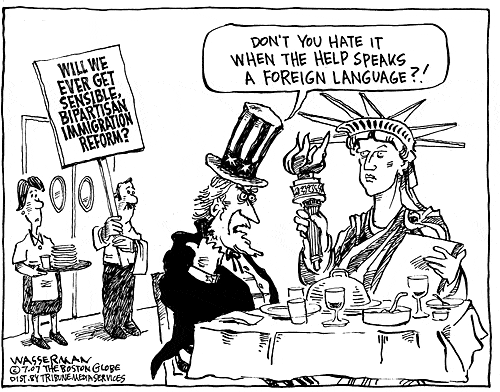
Related image
Wasserman, Immigration Cartoon, 2019
I'm a fan of political comics, I think that this is relevant with the government and people who are very ignorant towards the immigration process so I think this is a good representation on how we need to change the immigration system.
For this Action project, I amended the naturalization test. The current test has 100 question with many opportunities to be right or wrong, meaning the questions weren't the most airtight and had a lot of options of answers. What I did was make my own test. I took questions off of the test and amended them, I chose the ones that I felt are the most important and tried to make them more frank.I also added a few scenario's about american citizenship that covers some of the question on the naturalization test but it makes it more practical to your everyday life.

Here are the four questions that I chose and how I amended them in bold.

Before: In what month do we vote for President?
             What is the name of the President of the United States now?
After: What is the name of the President of the United States now? When were they voted in?

Before: 13. Name one branch or part of the government.
After: Name all 3 branches of government?  What is one thing that each of them exclusively do?

Before: There are four amendments to the Constitution about who can vote. Describe one of them.
After: Describe the requirements for voting, according to the constitution.

Before: What is the economic system in the United States?
After: What is the economic system in the United States? What does that mean?

Here is my Argument.
        Knowing something without context is useless.
        Explanation is a good way to learn context.
        The test should have more question that asks for explanation.

I think that this unit was very thought provoking and challenging. I had to use empathy and my knowledge of the US laws to create this test. There were many times that I felt under-qualified to make this and even intrusive because I know many people who are greatly affected by US immigration laws, I had to use different perspectives. My main inspiration for what I did was my teachers and I used my past experience on taking tests. I think that it was a useful project nonetheless.

Wednesday, February 13, 2019

I Declare Anthropology!

Below, you can see my declaration for independent study. This is my first Action project for my Humanities course called A Nations Argument. During this course my classmates and I learned the framework of an argument and what makes a successful argument. We had a great opportunity to be guests at the Cook County Courthouse for a black history program and were able to see the opening statements of a live trial following an interactive panel of successful black workers who have a career in law. We also focused on the declaration of independence and that's what really led us up to this project. Inside of the declaration we saw a good example of a successful argument. What my job was for the Action Project was to make a declaration of my own for independent study. 

I chose to do someting that has to deal with human behavior and observing it. Human behavior and observation by themselves are very broad subjects to study. I had to narrow it down in order to create an airtight argument. With the help of my teacher, we came to the decision that what I was looking for was the subject of Anthropology. That STILL being a very broad subject, I did some research and was finally able to narrow it down to Structural Anthropology. Structural Anthropology is a subject inside of Anthropology, some know it as socialism. It is based off of the idea developed by Claude Lévi-Strauss.


Saturday, January 19, 2019

Stand by me: A Contextualist Film Review

I'm wrapping up my 3rd and final unit of Ollywood. So far, I've studied pre production, production, and now I have a decent amount of knowledge of post production. In this unit, we studied the different components of post production. Sound is an important part of film production, I think in this unit, it was my favorite thing to learn about because it was so interesting. We also learned about editing the video, CGI, and the film score (which is basically the film's soundtrack). To put our skills to the test, my teacher assigned us a group test. This is when we got to make nano-films (15-30 sec. films) and  we had to include all of the components of production, especially editing. We had to do that earlier in the course also, both times a really enjoyed doing it. For our last field experience, we got the opportunity to go to Morning Star, an investment company. The way that fit into our curriculum is that they have a video production studio. I got to meet and discuss with a a video producer and a motion graphics specialist. It was a really informing and inspiring field experience. Another cool thing that we learned about was film criticism theory and the different types of approaches you can take to reviewing a film.

Image result for stand by me
Stand by Me, Rob Reiner, 1986

For each Action project of this class, I had to make a film review, so for my final Action project in Ollywood, we had to choose a movie on a list that my teacher gave us and analyze it. I chose Stand by me, directed by Rob Reiner. I had the option to review this film through many different lenses, such as feminist, auturist, or dualist. I'll be reviewing this film through a contextualist lens. That means that I will be looking at the bigger picture and symbolism within the film. How does this film mimic us and society as a whole? I believe that if you look closely enough, everyone has this experience. It can be the exact same one, almost getting hit by a train and finding a dead body or it can be something as simple as looking for your lucky quarter in the girls locker room but finding out something more meaningful in the process.


This was a very fun project. I think so far, this has got to be my favorite course that I have taken. I really admire directors, screenplay writers, actors  and everyone else who helps the production of a film. I got the opportunity to learn so much about something that I already really liked. I think out of all 3 units, pre production was my favorite because I love the costume design and set design process. I’m also glad that i finally got the chance to watch Stand by me so I can finally understand all of the references.

Tuesday, December 25, 2018

A Chicago Movie Critique

I’m taking a course called Ollywood. in the class we combine all of the components of film from everywhere, hence the name ‘Ollywood’ as opposed to Hollywood or Bollywood. In the first unit we studied pre-production and I had to make a Wriiten critique on the 1976 interpretation of Carrie analyzing the pre-production. For my second unit, my classmates and I learned about the production of the film. The production includes things like acting, framing, angles, and lighting. For my Unit two action project, I got the opportunity to watch the 1960 film, Psycho. I worked with my partner, AS and we discussed the production of the film. 

Here’s a link to her blog where you can find our video. 


I would say that both my partner and I are film enthusiasts and we were really excited to make this video. I really enjoyed being able to discuss it with someone else and get her view on everything as well as seeing what we didn’t agree on. My partner did a very good job editing the video and I’m glad that we chose Psycho. 

Psycho, (1960)

Monday, November 26, 2018

Carrie: The iconic Horror movie of the 70's

For my first elective term here at GCE, I'm taking a class called Ollywood. We're finishing up our first unit of the class. During this unit we went on a field experience to Lower Wacker Drive to expirience what it would be like for a location scout.  We are currently learning about the pre-production aspects of film. Some things that we are discussing is set design, dialogue and inspiration. All three of those things have to do with the elements of film production that I got to learn about and John Yorke's spill on what makes a good screen play. For my first Ollywood Action Project I made a film critique for the 1976 adaptation of Carrie and I touch bases of everything that we discussed for the first unit.

Carrie: A Film Critique

Everyone’s familiar with the captivating stories of Stephen King that gives off an undertone of truth. The novel Carrie was the first of many published by King. According to King’s official website, it says that the inspiration of Carrie came from two girls that he knew from high school. The screenwriter, Lawrence D. Cohen made a draft for Carrie in about six weeks, which was very similar to the actual novel. That wasn't the only adaptation he wrote for Stephen King, he also wrote the script for IT. Brian De Palma in addition to being the director of Carrie, he was also the director of Scarface, Mission Impossible and many more. In an interview, Brian De Palma says that Psycho inspired Carrie in some factors.

The the 1976 film directed by Brian De Palma, Carrie is a riveting adaptation of Stephen King’s Novel. This film is chilling, twisting, and will leave you grateful for the mother that you already have. The plot of the story is like any other coming of age film, an outcast teenage girl reinvents herself and the jock boy realizes that she was beautiful all along, the girl becomes more comfortable in her skin and becomes prom queen. Except that in this film, what follows is not so ordinary. Carrie is a coming of age film gone wrong. The protagonist of the film is Carrie White, portrayed as Sissy Spacek is an isolated teenage girl who just wants someone to accept her and give her love. Her mother, the antagonist of the film, Margaret white portrayed as Piper Laurie who is abusive and very obsessive when it comes to her religion.

Carrie (1976) Prayer closet 

In my opinion, if you missed the beginning of the film, it’s useless to watch the rest. You can almost automatically see that Carrie is an outcast. The setting is outside while a girls P.E class is happening. The uniforms give away that the film was not taking place in the modern day. I’m sure if you look at any old highschool film, you’ll see a similar costume for P.E. The teens are playing volleyball and if you look at Carrie’s awkward stance and her facial expressions of dread, it gives away the fact that she doesn’t fit in. Next in the girls locker room, an important scene of the film. While she is showering, Carrie starts her period for the first time. At the time she wasn’t aware of what this was and thought that she was dying. She then hysterically begs for help from her classmates, they laugh at her while she feels as if she is facing her last moments. Another important scene takes place in the principal's office, here is when the audience fist see’s the use of her powers. Carrie is frustrated with the principal mis-saying her name and flips the ash tray onto the floor using her telekinesis. Miss Collins intervenes and just tells her to go home. Being dismissed from school, she goes home. There she faces her mother who punishes her for getting her period by making her repeat biblical references and locks her into a closet, convinced that Carrie getting her period was brought on by sin. Inside is decorated with props like Jesus crucified and a candle with pictures of Jesus to ensure the closet to be seen as a prayer closet.

The house was a perfect setting for the Whites. The outside is gothic, old and continues on to the inside. You can tell that the inhabitants don’t care much for materialistic items. It’s simple and modest. The costumes of the Whites reflect the same as the house. I think that it stands out from the rest of the characters. Some may argue that the costume design of Carrie is a reflection of adolescence sexuality, and again, coming of age. In the beginning of the film, while in P.E, you can see Carrie’s costume is fitted differently than other girls. Her shirt appears too big going past her hips and untucked. The regular clothes that Carrie wears is also baggie and looks like Margret still picks out her clothes. She wears long, modest skirts throughout the movie. Her hair is rough and she uses it a a shield, messing it up when she’s distressed. This makes Carrie look childish or pre-pubescent compared to the other girls at school. It’s deliberate to be received as a virgin Mary type modesty. A dramatic moment for character development appears when we see Carrie getting ready for prom. We see Carrie in her broken mirror while getting ready for Prom. Her mom walks out of the shadows “I might’ve known it would be red” she says, Carrie corrects her, its a soft pink. I think this shows that she was still that innocent girl.

Later on in the movie, Margaret finds out that Carrie is going to prom and of course, detests it by hurting herself and taunting Carrie by telling her that “he’s not coming” or “they’re all going to laugh at you”, this describes Margaret's character well by showing how manipulative she is towards Carrie. Even then, Carrie was still trying to find maternal comfort in her mother but it doesn’t work. Carrie then goes against her mother and uses her telekinesis by overpowering her mother. This scene was also very interesting because it shows the vulnerability of Margaret and we as an audience haven't really seen that until now.

My favorite scene was Prom when Carrie got called to the stage because everything is so pretty, if you walked into the theater knowing nothing about the movie, you really can’t tell what’s happening next. Everyone’s clapping and the music and visuals are dreamy. It’s deceiving, the calm before the storm kind of. Then after that all of a sudden, she's covered in blood. Everything is silent and you can feel the tragedy in your heart. At that moment I didn't want to breath and it was almost as if I myself was in the audience. You can see what I mean in the within the first minute of this clip.


The protagonist of the film, Carrie has one desire overall. That desire is to be cared for. Carrie getting her period awakens that desire. That was the Inciting incident because not only in her life, in so many other young girls lives, that is what creates the bridge from being a girl to a woman. Most people, even if they don’t have friends, has family who loved them and had a home they can go home to and feel accepted. Carrie did not have that. She came home to the antagonist, the villain of her life. She didn’t even have a dad, he died when she was younger. The journey that Carrie took to pursue that desire was left undone due to the unexpected prom incident, which was the crisis, the moment that led up to the climax of the film. The Climax, the final showdown between protagonist and antagonist was the death of Margaret. In the end, she really didn’t find that love. Although the audience can see that Miss Collins cared for her, I don’t think Carrie was satisfied with that. I believe she just wanted a mom to love her and that’s probably what she needed too. Overall, I would say that this film was successful in pre-production.

Friday, October 19, 2018

2019 Mayoral Candidate Magazine

Image result for amara enyia mayor 2019
For my Fall Humanities class, we studied rhetorical appeals such as ethos, logos, and pathos. Another thing that we focused on was the status quo and how people challenge it. The mayoral Candidate that I have to study is Amara Enyia and she is well over qualified to be Chicago's mayor for 2019. During this unit we visited the Chicago History Museum to view the Dr. MLK Jr exhibit to get ready for our action project (AP). The AP that was assigned this unit was to make a sort of exhibit for our candidates. My classmates and I were encouraged to use the medium of our choice and I decided to create a magazine based on Amara's Candidacy.

In my Magazine you will see an exert from an article about the Jason Van Dyke trial. Amara starts off her thoughts with a declarative statement. By doing so, she mentions how Chicago needs a public safety plan, which is one of her top priorities. Amara uses an imperative sentence when she said "Moreover, we must evaluate how our city budget prioritizes police infrastructure over the necessary investments in an inclusive economy, affordable housing, mental health services, and other components of thriving communities.", its an imperative sentence because she commands us to evaluate. In Amara's text on why she's running, she uses exemplification by explaining why Chicago metaphorically lives in two cities, which I found very interesting
Below, I've made a slideshow to show my magazine.


Sunday, September 30, 2018

Amara Enyia Mayoral candidate 2019


In my Humanities class: Rhetoric, our first unit was called Suppose. In this unit we studies all of the components of rhetoric. My teacher wanted us to focus on the Chicago mayoral election. During this unit, my classmates and I had two visits, one from Troy LaRaviere, who is a 2019 mayoral candidate. Troy talked to my class about his views on Chicago and what makes him stand out from other candidates. Our other visitor was Ted Miin, he came to my class to talk about peoples assembly's. My class is planning on putting one together so he came in to help us construct one. We also had an external field experience to a memorial of MLK at Marquette park, at the intersection of 67th and Pulaski. There we met Alia Bilal and she educated us on the history of that site.
 
For my action project, my class had to chose a candidate running in the 2019 election to look into. My candidate is Amara Enyia, she is a lawyer and activist with a phd. With our chosen candidate we have to make a script of them answering a question we made for them.

MW. Amara Enyia 2019. (2018)

Why do you feel like creating a public bank for the city is something you should focus on rather than other issues?


The inclination & Human impact of Biodiversity

This is my final AP of my senior year. For my class frontiers, I wrote a research paper on one of the Grand Challenges. I chose challenge ...