Friday, December 20, 2019

Professional immersion with LightThink


At my professional immersion experience, the mission of what I’m doing with LightThink is to make meaningful design. At the beginning we started somewhere completely different to where we are now and where we plan on going. We’re creating new ways to look at GCE and Chicago as a whole. Along with my coworker and host, we come up with different ways to look at a problem and how we can solve not only that problem alone but other problems connected as well. I usually don’t like history but through this experience, I’m learning that what I educate myself on can spark new ideas and help me in the long run, this has made me more patient. 


In this P.I.E, I’m also learning valuable business, entrepreneurial skills which I think would 100 percent help me in the future. My biggest takeaways would have to be paying attention to detail and focusing in on things, even if it isn’t completely engaging. A lot of times, I found out that what we’re learning is easily applicable to a widespread audience, and not just what I’m doing. I will use these skills to be bold with what I do and make it into something big and limitless.Innovation and thoughtfulness has been something that has been the backbone of our process. 


Sunday, November 17, 2019

Shadow affairs within the US economy

The United States Economy is a complex system. There are many things that go into our economy running well or possibly recessing. I was able to learn what it means to be a part of a system for my Economics, Risking Value course. During this unit, we looked at a book titles “Doughnut Economics - 7 ways to think like a 21st-century economist.” by Kate Raworth. In order for my classmates and I to comprehend each principle, we each learned one and taught it back to each other. I had the fourth chapter, “Get Savvy with Systems”. As well as learning about doughnut economics, we had an external investigation to visit Rheaply, a business built on the concept of having a circular economy. To apply all of the things that I investigated, I elaborated more on an economic perspective. The perspective that I chose was something that I thought about a lot during this course, which is shadow affairs and corruption with the United states economy.

Shadow affairs within the US economy

Summery:
        Whether it's abuse of power or illicit activity, shadow affairs are activities that aren’t accounted for officially in the United States Government or overlooked. This principle will specifically cover exploitation of wealth and power as well as other factors such as fraud, drug transactions, and government corruption. Although black market transactions and wall street transactions seem to be on opposite ends of the spectrum, both can end up being detrimental to everyone else and our economy as a whole. Ultimately, shadow affairs need to be brought into light to have a somewhat fair economy.

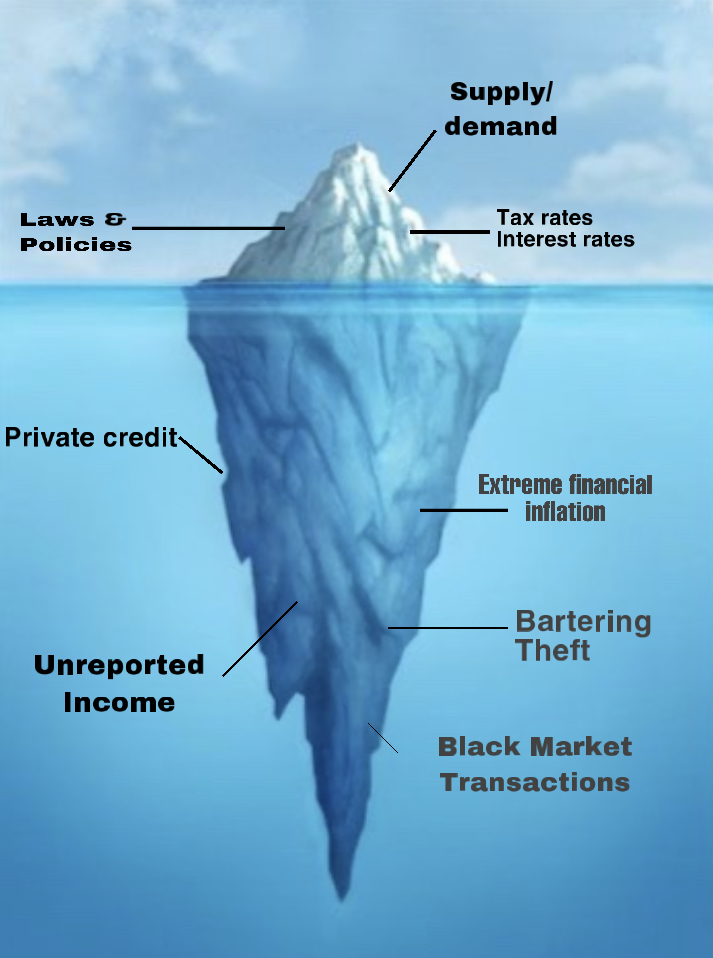
MW, Iceberg of the Economy, 2019
Further Context:
        In Doughnut Economics, Kate Raworth talks about how we need to get savvy with systems. Throughout the book she pushes the idea that our thoughts and everything that we know about economics should be questioned.
        Shadow affairs within the US economy is pushing a similar narrative. The underground economy consists of the black market, smuggling, unreported income and more. This actively harms our economy by tampering with official statistics that’s used to determine taxes.
        Black market transactions aren’t the only thing harming our economy. We’re made to believe that the white collar workers on Wall Street are helping our economy grow but its causing more harm simply through their capitalistic traits, often overlooked by the government. There are too many factors that are negatively affecting our economy and there’s no way we will be able to rightfully thrive unless we rethink and directly address these issues. Raworth says “It’s time to stop searching for the economy’s elusive control levers and start stewarding it as an ever evolving complex system.” I believe that we are so used to questioning what so obviously wrong, powerful individuals and institutions have gotten comfortable with the idea of exploitation but what about the unethical role that private banks and financial institutions have in harming our economy? According to the BIS (Bank for international settlements) when private credit becomes larger than the GDP, it slows productivity growth. According to the World Bank data, private credit has reached as high as 206% of our GDP within this decade. This is just one of the many serious indications that we have to holistically account for all things affecting our economy.

       This project seemed simple on the surface but just as the illustration shows, there was more beyond that. As I kept researching different subjects that would add to my principle, I fell down the rabbit hole.The reason that I chose to do my project on this is because I wasn't familiar with any theories or principles that was based on the shadow economy or economic exploitation. This made it harder to put what I wanted to say in words and research my ideas. Nevertheless, it was stimulating to build my argument as if I were a 21st century economist. There are so many things that go into an economy and that’s what this class has taught me. I think the best part of this project was how as I kept researching, I was able to put together information that I learned during a course I took last year called Policy.

Citations-

1) Cecchetti , Stephen Enisse Kharroubi G, and Enisse Kharroub. “BIS Working Papers No 381 Reassessing the Impact of Finance on Growth .” Https://Www.bis.org/Publ/work381.Pdf, Bank for International Settlements, July 2012.

2) “Domestic Credit to Private Sector (% of GDP) - United States.” Data, 2018, https://data.worldbank.org/indicator/FS.AST.PRVT.GD.ZS?end=2018&locations=US&start=1960.


3) “Plans: Elizabeth Warren.” Plans | Elizabeth Warren, https://elizabethwarren.com/plans.


Friday, November 15, 2019

Earl Sweatshirt: A Voice of the Generation

The following podcast is my final Action Project for my Journalism course. For the third and final unit, Sound , we focused on Audio journalism. The intentions of this project is to represent “The life of a voice” and their impact just through sound. I chose Earl Sweatshirt, a 21st century musical artist. For this podcast, I included recordings of 2 of my peers and used multiple soundbites to enhance the quality and entertainment of the project.


I’m pleased with the way this project turned out. I think this is my best project for the Journalism course. My biggest hurdle was deciding what information to include. Earl sweatshirt is one of my favorite artists so I have a lot to say about him. I had to look outside of my perspective and really try to think of what someone else would want to hear in order for this to be an easy listen. As always, I enjoyed discussing with other people about Earl sweatshirt. I did feel like sometimes it was tedious and if I were to do it again I would include more personal information or stories and less about his discography. In the end, I was really glad to see everything come together.

Pitchfork, "Earl Sweatshirt Does Not Exist", 2018

The Meaning of Your Life


Photographs impact our lives greatly. In my journalism course, my classmates and I explored different influential photographs and how they tie into being a journalist. There’s a lot that goes into taking a photo. In class, we learned about the different components of capturing something, those being: aperture, shutter-speed, focus, composition and the rule of thirds. For an external investigation and to test our abilities, we went outside of the classroom and used our own cameras to take photos while being aware of these different properties. To apply what I've learned in this unit, I did a project on the meaning of life.

I’ve never heard a clear meaning of life that applies to everyone across the board. There are too many circumstances and too many perspectives to have a clear cut meaning. For this project, I interviewed the people I am surrounded with. I talked with them about their identity and what their world looks like, ultimately leading up to me asking each person “What is the meaning of life?”


After interviewing my peers, I still don’t think that there is a clear meaning of life but that doesn’t mean that there isn’t one. Just like if you ask someone “what is love” there wouldn’t be a clear definition. Intentionally, each interview was as natural as I could make it. It was interesting to learn more about my friends and how they view the world.

Saturday, October 19, 2019

Assumptions of my future


Life is full of making decisions. Soon I will be making some of my most impactful decisions. What will I do after I graduate? How will my decision affect me financially? These questions are not easy to answer with so many options. For my Economics class, I’m learning about risks, opportunity costs, and how they affect an individual as well as a collective. My classmates and I went to Lyft and learned more about the market of a ride-share company. We also went to the Chicago Ideas week and listened to professionals talk about algorithms and big data. These experiences were both connected with this class and gave me insight on our economy as a bigger picture.

As a senior, I have a few ideas of what I want to do and how to get there but for this Action project, I focused on 2 completely different career and educational pathways so I can have some ideas on what's accessible and possible for me.

If you want to look at my choices more in depth, click here, or you can continue reading.
Econ AP1, MW, 2019


For both pathways, I made some assumptions.


If I were to go to Scripps college for an undergraduate degree in neuroscience, I assumed that:


- I will receive $35,00 in financial aid and $5,000 in scholarships.

- I will stay on campus all 4 years
With these assumptions, the cost of attending this school would be $168,264

(Year 1- $33,642
Year 2- $41,778
Year 3- $44,869
Year 4- $47,975)


To pay off the loans, it would take 16 years and my true cost, including the compounding interest would end up being $201,123, including $32,859 of interest. Here's a link to the full chart. 


 Becoming a psychiatrist 

Assuming that I would become a psychiatrist, I calculated my lifetime earnings.
MW, LIFETIME EARNINGS, 2019
This shows my salary going up as the years go by. The blue, red, and yellow lines represent my entry, middle, and senior level salaries. The cost of living increases so it only makes sense that my pay will increase too. In total, my lifetime earnings would be
Here is the supply of demand of psychiatrist
MW, Psych SD, 2019
This shows the employment and wage rise that is expected in the next 10 years as well as where it is now.
If I were to go to The New School, I assumed that:
-I would receive money from multiple sources (scholarships and student aid options)  adding up to around $50,000 
-I will stay enrolled into this school until I graduate 
-I will stay on campus for all 5 years
- I will be attending the BA/BFA Lang/Parsons program


With these assumptions, the cost of attending this school would be $140,194

(Year 1- $23,642
Year 2- $25,778

Year 3- $27,975

Year 4- $30,236
Year 5- $32,563)

To pay off loans for The New School, it would take 16 years as well. This leaves me with the true cost of $191,193 including $50,999 in interest paid. Here's a link to the full chart. 

Becoming an Art Director
If I become an Art Director, here is my intended salary and lifetime earnings.
Total Entry269722.1687
Total Mid 987059.1107
Total Senior7328860.989
Lifetime Earnings8585642.268
Here is the supply and demand of Art Directors. 
MW, SD Art Director, 2019
The growth rate is 1%, so the change is very small, the two lines represent that 1% growth for the next 10 years. 

While doing this AP, I was able to get more insight on one of the career paths. I talked to a doctor, who happens to be a friend of my mom's. The doctor that I talked to wasn't a psychiatrist exactly but I wanted to know if they enjoyed their life as a doctor and if they would ever go through all of those years of school again? "I absolutely would go through everything again, even though it wasn't fun, it was rewarding. I love being a doctor now." Dr. ED told me. I then asked him for advice and he left me with "You need to be disciplined, Study hard, be positive, and always remember why you started" 
With this information, I don't have a final decision of what I would want to do. Both paths have pros and cons. Ultimately my biggest takeaway was the amount of money an education costs. With both paths, the school costs aren't that much different but my salary cost had a substantial difference.
I compiled some pros and cons of each path 
The New School, Art Director
The pros of this pathway:
Graduate with 2 degree's
Be in a city that will be easy to get this career after graduating


The cons of this pathway:

Really expensive true cost
Scripps college, Psychiatrist
The Pro's
High Lifetime earnings
More education options


The Cons

Longtime payment
Longer school time

 I believe either path I would be okay with but I would for sure have to try to get more money in scholarships. Before this action project, I didn’t know most of these things that I’m displaying. Not only did this project give me the opportunity to explore my options and get a sense of what I want to do, financially and educationally wise. Researching different pathways left me with more confidence in what I can do after I graduate.
1 . ) “29-1066 Psychiatrists.” U.S. Bureau of Labor Statistics, U.S. Bureau of Labor Statistics, 29 Mar. 2019, https://www.bls.gov/oes/current/oes291066.htm.
2.) “Art Directors : Occupational Outlook Handbook:” U.S. Bureau of Labor Statistics, U.S. Bureau of Labor Statisticshttps://www.bls.gov/ooh/arts-and-design/art-directors.htm#tab-1
3.) “Scripps College Overview.” College Factual, 13 Sept. 2019, https://www.collegefactual.com/colleges/scripps-college/.

4.) “The New School Overview.” College Factual, 13 Sept. 2019, https://www.collegefactual.com/colleges/the-new-school/.

Friday, September 27, 2019

Disservices within Chicago Public Schools


The job of a journalist is to research, document, and share stories that you find important/meaningful. Being a journalist can be a dangerous job and can cost you your life. For my journalism course, my class finished out first unit, “Text”. In this unit we learned what it takes to be a journalist as well as a consumer throughout the different time periods. We analyzed different parts of an article: like the headline, how you would capture this information/ the readers and how you can communicate a message. This led to me thinking about what I could write about.

Disservices within Chicago Public Schools

        “We’ve been using the same books for 10 years. We can't afford anything.” says 17-year-old Kayla who attends King College Prep. Chicago is notorious for having unjust school systems in lower-income neighborhoods predominantly on the south and west sides of Chicago. It’s not news that public schools don’t have the best funding or functionality, some schools more than others. But in circumstances as Kayla (and many others) describes it, there’s an obvious disadvantage to students who go to schools in minority dense neighborhoods. Teachers coming and going has been a big problem within the CPS school system, as well as having fewer resources than other students in higher-income neighborhoods.
        Instability within the staff at schools is detrimental to the success of students. Often when teachers are coming and going frequently, students become less engaged and are less likely to be motivated to learn. “We just lost like 7 teachers and only 3 of them were replaced.” says Kayla. Fewer teachers can translate into many issues. Teachers can likely be coaches or sponsors, helping with extracurricular programs such as sports, or academic teams within the school. Class size is very important to your learning success, it’s easy to trail off in class when you have 20 plus classmates. It may be even easier to overlook a student with an intolerable workload. This may cause a decrease in test scores leading to less funding, something that schools like this have been struggling with already. With fewer teachers, this means that there will be less and less programs to offer. At King College Prep, a librarian no longer worked there, and so students were not allowed to access the library for a year until they were able to find a new teacher, depriving them of a consistent space to study.
        Kayla talks about how she wishes she could experience what other students can .Barely even 5 miles north of her school, a senior, also at a selective enrollment school likely experiences school completely different. At a school like Walter Payton or Jones college prep, the school offers so many resources; 70+ clubs/activities, global class trips, and room for more teacher/student interaction. These things are something that they’re known for. “I think it's unfair to see students within the same system experience a completely different academic environment,” she then continues to express her point “I have friends who attend Walter Payton College Prep and we’ve discussed the difference in numbers with extracurricular activities and clubs. Payton has over 70 clubs while King is losing clubs yearly.”
        This is just one unfortunate situations out of countless others. Talking to Kayla really brought insight to a situation that not a lot of people acknowledges nor try to change. For many students, school is a sanctuary but it truly is providing a disservice to students while simultaneously setting them up for failure in higher education to allow students to continue to attend schools with subpar conditions and education. Every student deserves equal opportunity and hopefully under the new mayoral administration in Chicago, that would be something attainable.


        Deciding to write about this topic came from me having friends who go to public schools here in Chicago and I wanted to know more about my friends perspective. I was able to empathize, having experienced completely different highschools myself. I hear about what they have to go through and how it compares to other schools in Chicago and it’s wrong. Public schools have to fix their system. This project worked out perfectly because I was already with my peer who I interviewed and we regularly have conversations like this. I’m glad I could write an article about this.

Thursday, June 6, 2019

The Policy Podcast; Terminiello v. Chicago (1949)


I'm closing the Chapter for junior year humanity courses. That means that I'm ending my policy course. This course was different for me. I never learned about the government in such an extensive way as we did this term. I'm grateful for everything that I learned about because now my classmates and I have more knowledge on what it means to be a citizen of America, as well as learning different perspectives outside of American citizenship. The first unit we learned about the Legislative branch, the second unit, we learned about the Executive branch. In this unit, we learned what the Judicial branch of the government is all about. Learning about the government, we of course will see some terms that aren't common so my teacher gave us some legal terminology to define. Knowing those terms, it made subjects easier to comprehend. I now understand how a case reaches the Supreme Court. While understanding the process of a case being handled, I got to get to know more of what it means for something to be constitutional or not. So, with learning about the supreme court, we researched different cases, specifically all of the landmark cases, such as Roe v. Wade and Brown v, Board of education. This might've been the most impactful unit for me because I really got a sense of how change happens within the legal world. Some of the cases were even inspiring because it shows that change is worth fighting for and without the fight, nothing will change.

To represent everything that I learned this unit, I made a podcast talking about Terminiello v. Chicago (1949).


There are a lot of interesting and necessary Supreme Court cases, it's not easy to just pick one to look more into. I first thought that I was going to choose Tinker v. Des Moines but someone recommended me to look at Terminiello v. Chicago and I never heard about it. I chose this case after looking at it more because I though it was more interesting than my former choice, although they both have to do with our First amendment rights. I enjoyed making this podcast and while trying to explain what I learned, I even ended up learning more.

Citations
“{{Meta.pageTitle}}.” {{Meta.siteName}}, www.oyez.org/cases/1940-1955/337us1.

“Terminiello v. Chicago, 337 U.S. 1 (1949).” Justia Law, supreme.justia.com/cases/federal/us/337/1/.

Reports of cases adjudged in the Supreme Court of Pennsylvania : [1828-1835] / by William Rawle, jun. ; with notes referring to cases in the subsequent reports by William Wynne Wister, jun

The inclination & Human impact of Biodiversity

This is my final AP of my senior year. For my class frontiers, I wrote a research paper on one of the Grand Challenges. I chose challenge ...